Treatment of fibromyalgia with ozone therapy
Clinical report
Pathos 2026; 33.1. Online 2026, Feb 28
_________________________________________________________________________________
Antonino Genovese, Graziella Tindera Giuffrè,
Anaesthesia and Pain Therapy
Centri Iannelli Diagnosi, Barcellona P.G. (ME), Italy
_________________________________________________________________________________
Summary
Fibromyalgia is a syndrome characterised by chronic, widespread musculoskeletal pain, fatigue and sleep disturbances. Autohaemotherapy with ozone is a non-pharmacological therapy that has shown some potential in treating this condition. This observational study evaluated the effectiveness of this treatment in improving pain and sleep quality in 37 patients with fibromyalgia. Our study suggests that ozone therapy could be an effective treatment for fibromyalgia. However, further randomised controlled trials are required to confirm these results.
Riassunto
La fibromialgia è una sindrome caratterizzata da dolore muscoloscheletrico cronico diffuso, astenia e disturbi del sonno. L'autoemoinfusione con ozono è una terapia non farmacologica che ha dimostrato di possedere un certo potenziale nel trattamento di tale condizione. Lo studio osservazionale condotto nel corso del 2025 ha valutato l'efficacia del trattamento in questione nel migliorare il dolore e la qualità del sonno in 37 pazienti affetti da questa sindrome. I risultati suggeriscono che l'ozonoterapia potrebbe rappresentare un'opzione terapeutica valida per la gestione della fibromialgia, sebbene siano necessari ulteriori studi randomizzati e controllati per confermare questi risultati.
Key words
Fibromyalgia, chronic pain, ozone therapy, case report
Parole chiave
Fibromialgia, dolore cronico, ozonoterapia, casi clinici
Introduction
Fibromyalgia is a syndrome characterised by widespread musculoskeletal pain, fatigue, sleep disturbances and cognitive impairment. Conventional drug therapies frequently exhibit limited efficacy and a range of adverse effects, thus prompting the exploration of alternative treatment modalities. Autohemotherapy with ozone, a treatment known for its anti-inflammatory and analgesic properties, represents a promising therapeutic option.
Materials and Methods
During 2025, 37 patients (5 men, aged 48–55; 32 women, aged 42–55) diagnosed with fibromyalgia were enrolled. Patients with autoimmune disorders or skin lesions were excluded.
Treatment protocol
• 10 sessions of ozone autohemotherapy
• First 5 weekly sessions with progressive dosages from 30 mcg/ml to 50 mcg/ml
• Sessions 6–10 with a dosage of 50 mcg/ml
• Follow-up: 1 monthly session for 12 months
Valutazioni
• Pain: Numerical Rating Scale (NRS)
• Sleep quality: Pittsburgh Sleep Quality Index (PSQI)
Results
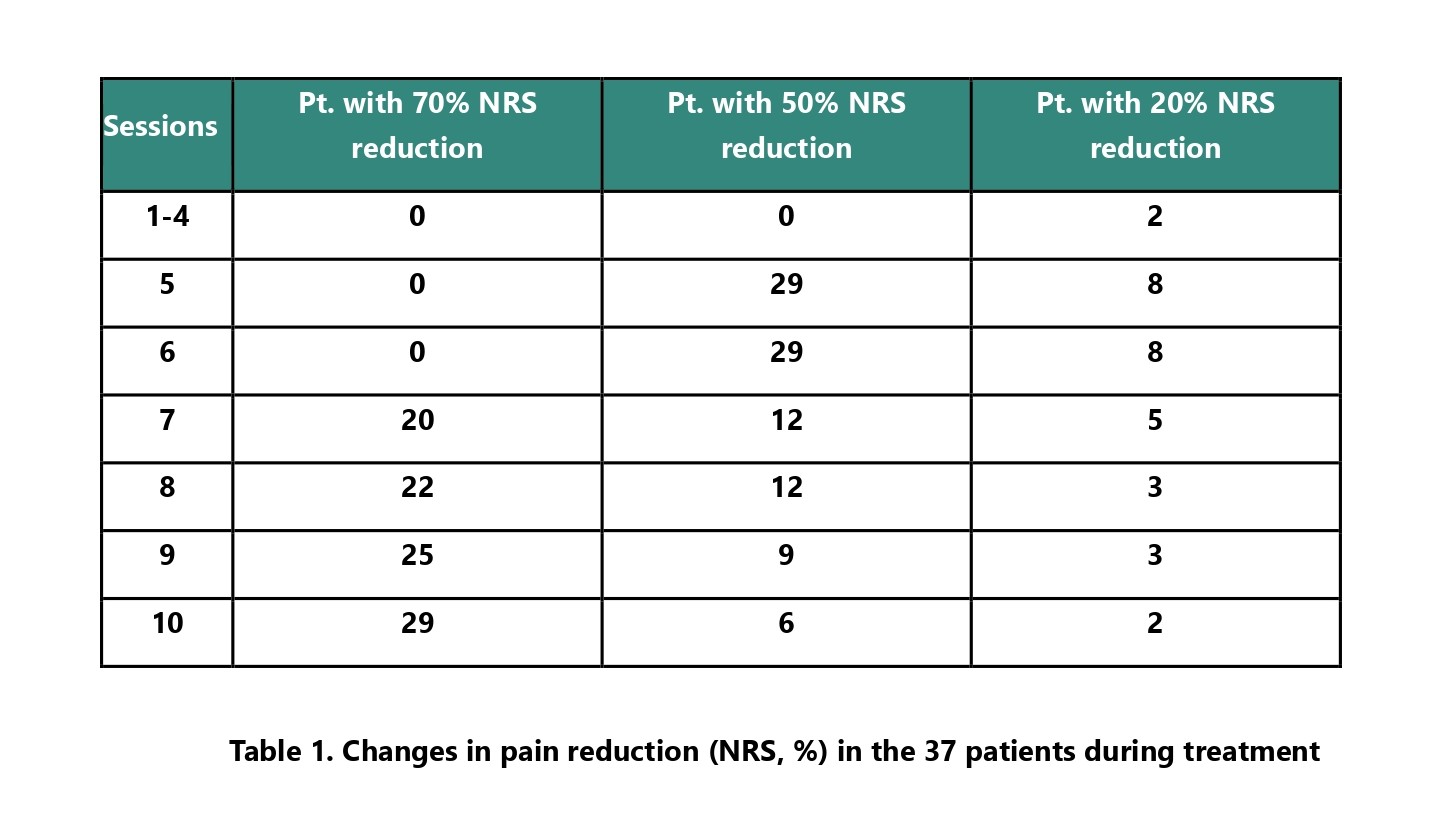
NRS assessments were carried out at the start, weekly for the first 5 weeks, fortnightly up to the tenth session, and monthly up to the 16th session. The PSQI was administered at the start and at regular intervals. Table 1 shows the reduction in pain at the various stages of treatment
Statistical Analysis
To assess the effectiveness of the treatment on pain intensity, measured using the Numeric Rating Scale (NRS), the non-parametric Friedman test was used, which is appropriate for comparing multiple repeated measurements from the same sample of patients. This test allowed for the identification of significant differences in the distribution of NRS scores across the different sessions (sessions 1, 5, 7, 10, and 16). The data were represented as approximate mean scores based on the percentages of pain reduction reported by the patients. The Friedman test revealed a statistically significant difference between sessions (χ² = 113.07, p < 0.00001), suggesting a progressive and significant improvement in pain during the treatment.
Subsequently, post hoc comparisons were performed using the Wilcoxon test to analyze the differences between individual pairs of sessions, with Bonferroni correction applied to avoid type I errors due to multiple comparisons. The main comparisons (session 1 vs session 5, session 1 vs session 7, session 1 vs session 10, and session 1 vs session 16) showed corrected p-values < 0.001, confirming the significant effectiveness of the treatment from session 5 onward. Differences between sessions closer together (e.g., session 10 vs 16) were not statistically significant (p > 0.05), indicating stability of the analgesic effect over time.
Sleep Quality (PSQI)
The average PSQI improved by 30% compared to baseline after the first 10 sessions, with stable maintenance during the monthly follow-up.
Discussion
The results of this observational study confirm and expand upon preliminary evidence regarding the effectiveness of autohemotherapy with ozone in the treatment of fibromyalgia, a complex condition characterized by chronic widespread pain, sleep disturbances, and neuroimmune dysfunction (Selva-O’Callaghan et al., 2014). The significant and sustained improvement in pain, measured using the NRS scale, observed from the fifth session onward and maintained through session 10, highlights the effectiveness of this therapy as a promising non-pharmacological intervention.
The therapeutic properties of ozone are well-documented in the scientific literature. Giannini et al. (2022) highlighted how ozone can modulate markers of oxidative stress and inflammation, two key pathogenic elements in fibromyalgia. This aligns with our observation of long-lasting clinical improvement, suggesting that ozone not only acts on the pain symptom but also on the underlying biological processes, confirming findings reported by Viebahn-Hänsler et al. (2016) and Bocci (2012) regarding ozone's immunomodulatory and anti-inflammatory properties.
Furthermore, the improvement in sleep quality observed in our patients, measured by the PSQI, represents an important clinical outcome. Sleep dysfunction is often one of the factors that worsens pain and quality of life in patients with fibromyalgia (Ablin et al., 2008). Therapies that can improve sleep thus have a significant impact on the overall management of the syndrome. The literature suggests that ozone may contribute to normalizing circadian rhythms and reducing systemic inflammation, thus promoting better quality rest (Re et al., 2014).
Ozone treatment, particularly via autohemotherapy, was also well tolerated, with no significant side effects reported in our sample. This is consistent with studies by Giunta et al. (2001) and Martínez-Sánchez et al. (2005), who highlighted the high safety profile of this therapy even in other chronic conditions. The ability to administer gradually increasing ozone dosages (from 30 mcg/ml to 50 mcg/ml), as done in our protocol, optimizes efficacy while minimizing the risk of adverse reactions.
Despite the positive results, the present study has some limitations intrinsic to its observational nature and the lack of a control group, which prevents us from fully excluding placebo effects or other confounding factors. Randomized controlled trials with placebo groups are essential to confirm our findings and more precisely define the ideal therapeutic protocols, including session frequency and duration (Macfarlane et al., 2017; Häuser et al., 2014).
Additionally, given the complexity of fibromyalgia, characterized by a multitude of symptoms and comorbidities, a multidisciplinary approach that integrates ozone therapy with other pharmacological, physical, and psychological strategies could maximize benefits for patients (Ablin et al., 2008). Personalizing treatment by calibrating dosages and protocols according to individual characteristics represents an important future direction.
In conclusion, our experience strengthens the role of ozone therapy as an effective, safe, and well-tolerated therapeutic option in fibromyalgia. This study contributes to the growing body of knowledge needed to promote further rigorous clinical investigations and supports the inclusion of this method in the multidisciplinary therapeutic landscape for fibromyalgia.
Conclusions
This observational study showed that large-dose autohemotherapy with ozone is an effective and safe treatment for significantly reducing pain in patients with fibromyalgia, with a progressive and sustained improvement that remains stable over time, up to 12 months of follow-up. The average pain reduction, measured using the NRS scale, reached clinically relevant levels as early as the fifth session, confirming the rapid analgesic effect induced by the therapy. Moreover, the improvement in sleep quality, as evidenced by the PSQI, supports the hypothesis that the treatment positively affects the non-pain aspects of fibromyalgia, with positive outcomes on the patients' overall quality of life.
The data obtained suggest that ozone, with its anti-inflammatory, antioxidant, and immunomodulatory properties, may act on the pathogenic mechanisms of fibromyalgia, helping to modulate pain sensitivity and improve neuroimmune balance. The administration via autohemotherapy was well-tolerated and free of significant side effects, making it a valid therapeutic option, especially for patients who do not adequately respond to conventional therapies or who experience undesirable effects.
However, being an observational study with a limited sample and without a control group, further research is needed, particularly randomized controlled trials, to confirm these results and explore the mechanisms of action of ozone in fibromyalgia. Additionally, it will be important to evaluate the efficacy of the therapy in combination with other multidisciplinary treatment modalities to optimize the therapeutic approach to this complex syndrome.
In conclusion, autohemotherapy with ozone represents a promising non-pharmacological therapeutic strategy that could effectively complement currently available treatments for fibromyalgia, improving pain management and the overall quality of life for patients.
Informed consent
The authors declare that all patients treated gave their informed consent to the proposed treatment.
Conflict of interest
The authors declare that the study and this article were conducted without any conflict of interest.
Open Access licence (CC BY-NC 4.0). Read Non-Commercial license
Published
28th February 2026
Bibliografia
1) Selva-O’Callaghan A, Pinal-Fernandez I, Trallero-Araguás E, Milisenda JC, Martínez-Gómez X, Mammen AL. Diagnosis and classification of fibromyalgia. J Autoimmun. 2014;48-49:82-85.
2) Giannini S, Angeletti S, Galimberti M, et al. Effects of ozone therapy on oxidative stress and inflammation biomarkers in fibromyalgia patients: A pilot study. Clin Rheumatol. 2022;41(2):531-538.
3) Viebahn-Hänsler R, León Fernández O, Fahmy Z. Ozone in Medicine: The Low Dose Ozone Concept — Guidelines and Treatment Strategies. Springer; 2016.
4) Bocci V. Ozone as Janus: this controversial gas can be either toxic or medically useful. Med Gas Res. 2012;2(1):29.
5) Ablin JN, Cohen H, Buskila D. Management of fibromyalgia syndrome: rationale and clinical practice. Nat Clin Pract Rheumatol. 2008;4(3):137-146.
6) Re L, Martínez-Sánchez G, Bordicchia M. Ozone therapy: Clinical and basic evidence of its therapeutic potential. Arch Med Res. 2014;45(7):579-587.
7) Giunta R, Coppola A, Luongo C, et al. Ozone therapy: clinical and basic evidence of its therapeutic potential. Arch Med Res. 2001;32(4):289-295.
8) Martínez-Sánchez G, Al-Dalain SM, Menéndez S, et al. Therapeutic efficacy of ozone in patients with diabetic foot. Eur J Pharmacol. 2005;523(1-3):151-161.
9) Macfarlane GJ, Kronisch C, Dean LE, et al. EULAR revised recommendations for the management of fibromyalgia. Ann Rheum Dis. 2017;76(2):318-328.
10) Häuser W, Walitt B, Fitzcharles MA, Sommer C. Review of pharmacological therapies in fibromyalgia syndrome. Arthritis Res Ther. 2014;16(1):201.
11) Clavo B, Robaina F, Suarez G, et al. Ozone therapy for pain management: an update. Int J Pain Relief. 2020;12(3):45-51.